If you’re confused about the difference between medical appraisal and revalidation, you’re certainly not alone. It’s something I come across regularly when speaking to doctors, particularly international medical graduates (IMGs), locums and doctors taking time out of training.
The two terms are often used interchangeably, but they’re actually quite different processes. Understanding how they fit together can save you quite a lot of trouble further down the line.
The quick answer
Medical appraisal is your annual professional review. It’s an opportunity to sit down with an appraiser, reflect on your work over the past year, discuss what you’ve learned and agree some goals for the year ahead.
Revalidation is the process by which the General Medical Council (GMC) confirms that you can continue to hold your licence to practise. It normally happens every five years.
Think of it this way: appraisal is what you do each year to demonstrate that you’re maintaining and developing your professional practice. Revalidation is the larger checkpoint that brings everything together.
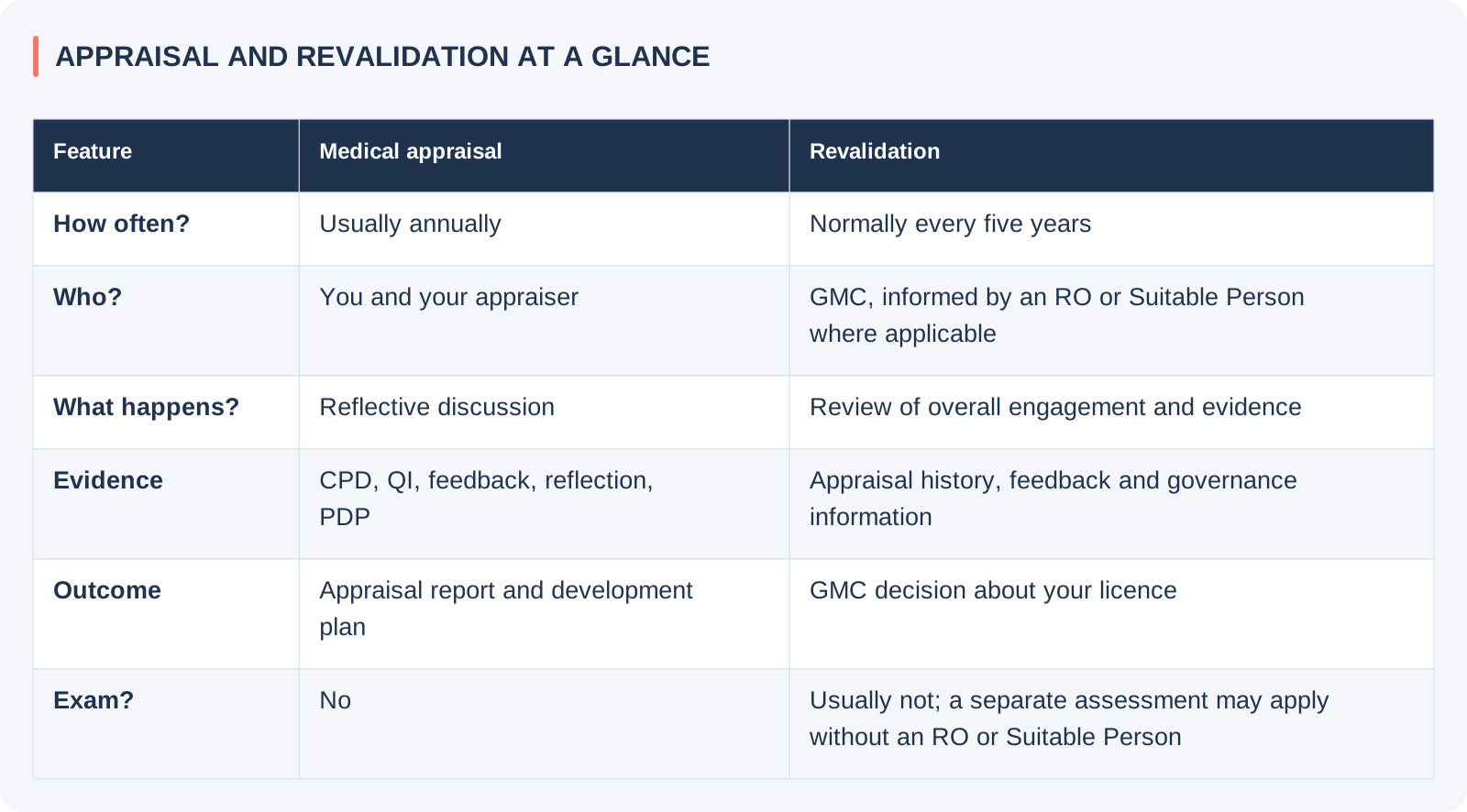
Appraisal and revalidation at a glance
How often?
- Medical appraisal
- Usually annually
- Revalidation
- Normally every five years
Who?
- Medical appraisal
- You and your appraiser
- Revalidation
- GMC, informed by an RO or Suitable Person where applicable
What happens?
- Medical appraisal
- Reflective discussion
- Revalidation
- Review of overall engagement and evidence
Evidence
- Medical appraisal
- CPD, QI, feedback, reflection, PDP
- Revalidation
- Appraisal history, feedback and governance information
Outcome
- Medical appraisal
- Appraisal report and development plan
- Revalidation
- GMC decision about your licence
Exam?
- Medical appraisal
- No
- Revalidation
- Usually not; a separate assessment may apply without an RO or Suitable Person
Read the text version
| Feature | Medical appraisal | Revalidation |
|---|---|---|
| How often? | Usually annually | Normally every five years |
| Who? | You and your appraiser | GMC, informed by an RO or Suitable Person where applicable |
| What happens? | Reflective discussion | Review of overall engagement and evidence |
| Evidence | CPD, QI, feedback, reflection, PDP | Appraisal history, feedback and governance information |
| Outcome | Appraisal report and development plan | GMC decision about your licence |
| Exam? | No | Usually not; a separate assessment may apply without an RO or Suitable Person |
How do appraisal and revalidation fit together?
The easiest way to understand this is to look at a typical five-year revalidation cycle. Each year, you complete an appraisal and gather evidence. When your revalidation date approaches, your Responsible Officer normally reviews the overall picture and makes a recommendation to the GMC.
Your five-year revalidation cycle
| Year 1 | Year 2 | Year 3 | Year 4 | Year 5 |
|---|---|---|---|---|
| Appraisal | Appraisal | Appraisal | Appraisal | Appraisal |
Supporting evidence throughout the cycle: CPD • Quality improvement • Patient and colleague feedback • Reflection
At or near your revalidation date: Responsible Officer or approved Suitable Person reviews the evidence and makes a recommendation
GMC makes the revalidation decision
You receive confirmation from the GMC by email or letter that you have been revalidated, together with your next revalidation date — usually around five years later.
This illustrates the usual route for a doctor with an RO or Suitable Person. Completing five appraisals does not automatically guarantee revalidation.
You don’t automatically need exactly five completed appraisals to revalidate successfully. Sometimes doctors have gaps because of illness, parental leave, career breaks or other circumstances. What matters is appropriate engagement, explanation of gaps and sufficient supporting information.
Why does this catch so many doctors out?
Imagine you’ve completed Foundation Year 2 and decide to take an F3 year. During foundation training, progression was managed through the training system, including ARCP. You probably never organised a conventional appraisal yourself.
You start locuming, intending to return to specialty training the following August. Then plans change. Your F3 becomes F4 or F5, and suddenly your revalidation date is approaching. You may discover you should have been engaging with annual appraisal throughout that time.
This is particularly relevant to IMGs who have obtained GMC registration but haven’t yet secured a first UK post. My advice is simple: don’t assume future training plans will take care of revalidation. Check your current arrangements.
But isn’t ARCP the same as appraisal?
Not quite. Both review a doctor’s progress, but they have very different purposes.
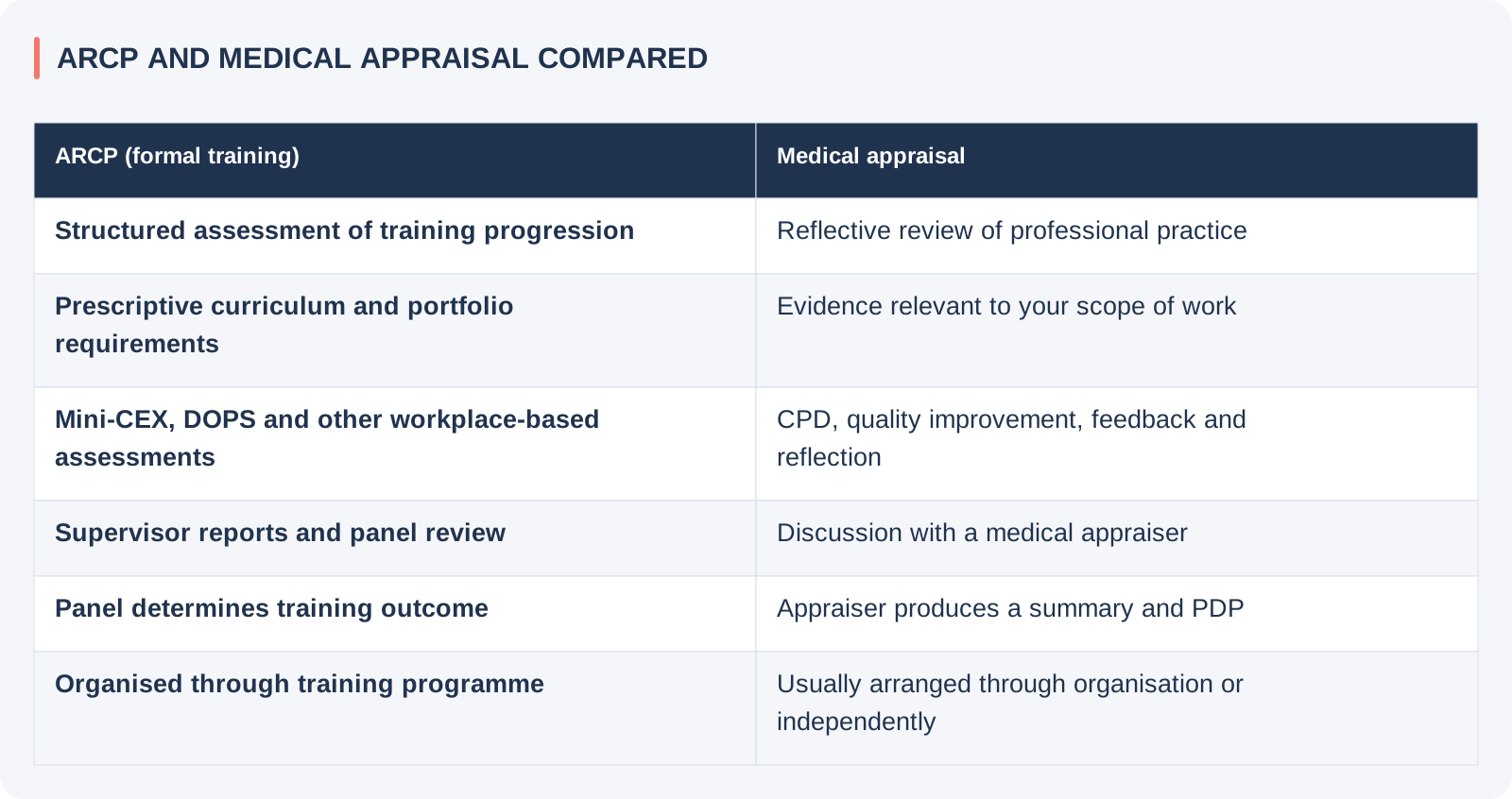
ARCP and medical appraisal compared
- ARCP (formal training)
- Structured assessment of training progression
- Medical appraisal
- Reflective review of professional practice
- ARCP (formal training)
- Prescriptive curriculum and portfolio requirements
- Medical appraisal
- Evidence relevant to your scope of work
- ARCP (formal training)
- Mini-CEX, DOPS and other workplace-based assessments
- Medical appraisal
- CPD, quality improvement, feedback and reflection
- ARCP (formal training)
- Supervisor reports and panel review
- Medical appraisal
- Discussion with a medical appraiser
- ARCP (formal training)
- Panel determines training outcome
- Medical appraisal
- Appraiser produces a summary and PDP
- ARCP (formal training)
- Organised through training programme
- Medical appraisal
- Usually arranged through organisation or independently
Read the text version
| ARCP (formal training) | Medical appraisal |
|---|---|
| Structured assessment of training progression | Reflective review of professional practice |
| Prescriptive curriculum and portfolio requirements | Evidence relevant to your scope of work |
| Mini-CEX, DOPS and other workplace-based assessments | CPD, quality improvement, feedback and reflection |
| Supervisor reports and panel review | Discussion with a medical appraiser |
| Panel determines training outcome | Appraiser produces a summary and PDP |
| Organised through training programme | Usually arranged through organisation or independently |
Doctors in GMC-approved postgraduate training normally meet their revalidation requirements through training and ARCP. A trust-grade post or locally organised IMT-equivalent programme is not necessarily GMC-approved training, so conventional annual appraisal may still be required.
Who actually makes the revalidation decision?
A lot of doctors assume their appraiser decides whether they’re revalidated. That isn’t how it works.
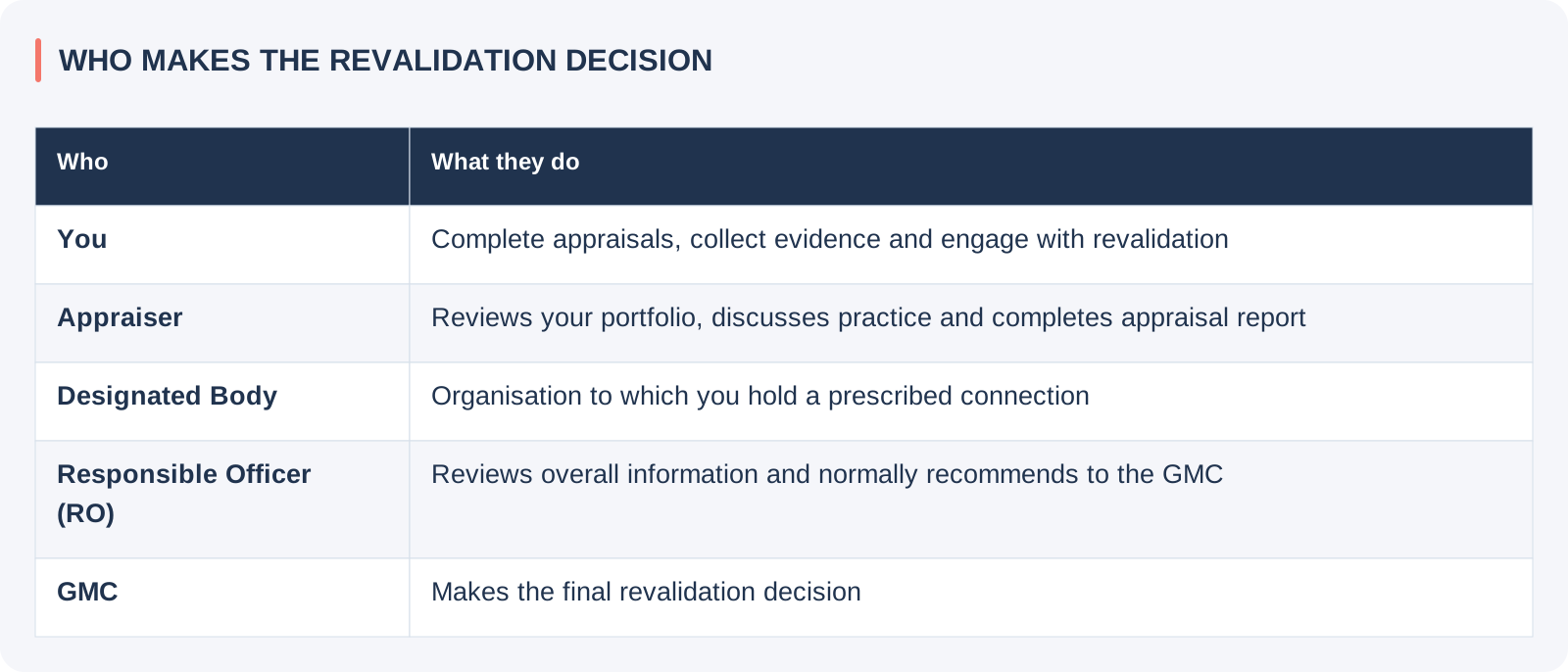
Who makes the revalidation decision
You
Complete appraisals, collect evidence and engage with revalidation
Appraiser
Reviews your portfolio, discusses practice and completes appraisal report
Designated Body
Organisation to which you hold a prescribed connection
Responsible Officer (RO)
Reviews overall information and normally recommends to the GMC
GMC
Makes the final revalidation decision
Read the text version
| Who | What they do |
|---|---|
| You | Complete appraisals, collect evidence and engage with revalidation |
| Appraiser | Reviews your portfolio, discusses practice and completes appraisal report |
| Designated Body | Organisation to which you hold a prescribed connection |
| Responsible Officer (RO) | Reviews overall information and normally recommends to the GMC |
| GMC | Makes the final revalidation decision |
You don’t normally need a separate meeting with your RO. They usually review appraisal history, supporting information and relevant governance information, and may ask for clarification. An approved Suitable Person may perform the recommendation role where there is no RO.
What evidence do you actually need?
The good news is that much of your revalidation evidence is the same information you’re already gathering for appraisal. You don’t normally need to produce an entirely new portfolio every five years.
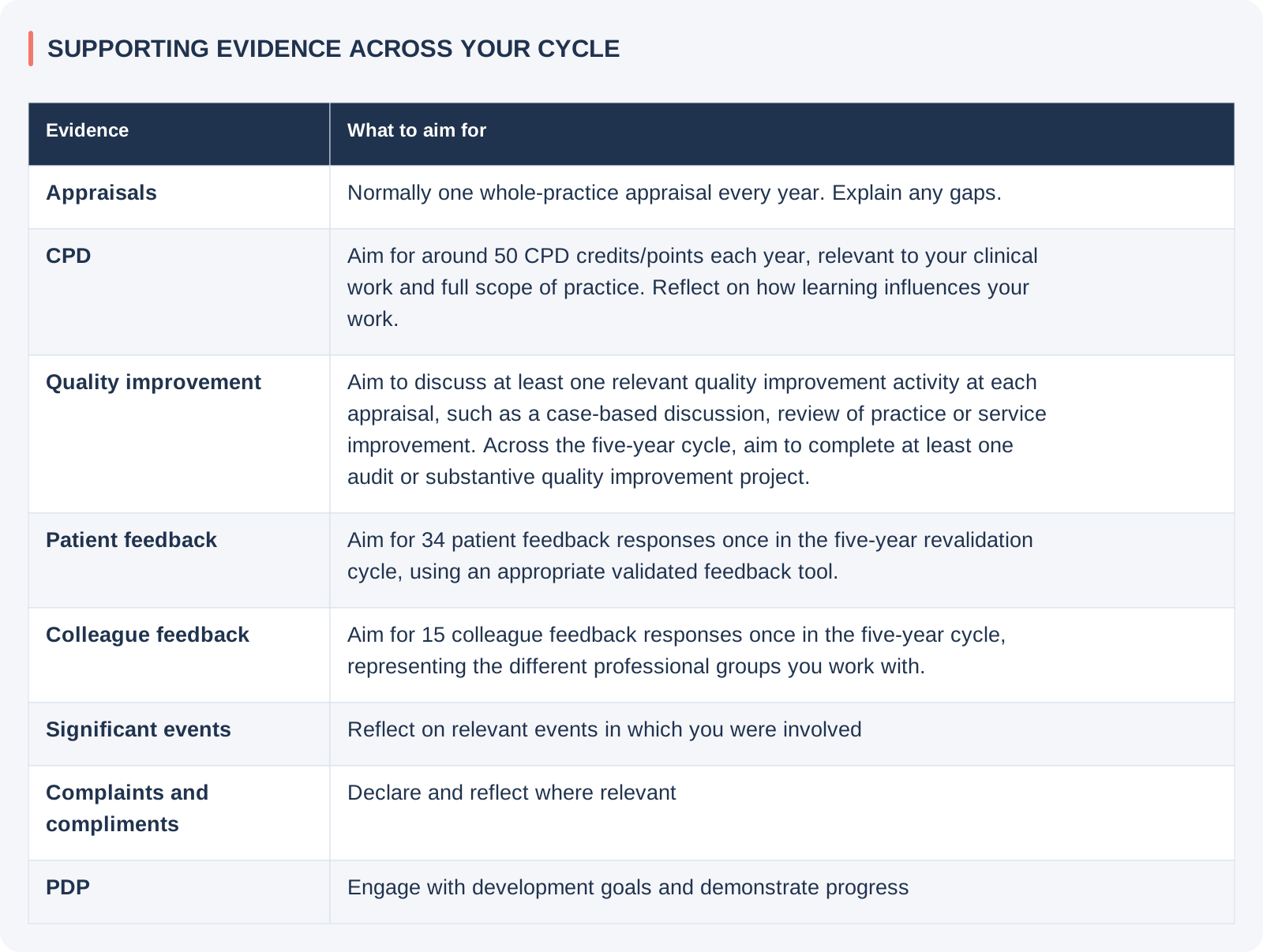
Supporting evidence across your cycle
Appraisals
Normally one whole-practice appraisal every year. Explain any gaps.
CPD
Aim for around 50 CPD credits/points each year, relevant to your clinical work and full scope of practice. Reflect on how learning influences your work.
Quality improvement
Aim to discuss at least one relevant quality improvement activity at each appraisal, such as a case-based discussion, review of practice or service improvement. Across the five-year cycle, aim to complete at least one audit or substantive quality improvement project.
Patient feedback
Aim for 34 patient feedback responses once in the five-year revalidation cycle, using an appropriate validated feedback tool.
Colleague feedback
Aim for 15 colleague feedback responses once in the five-year cycle, representing the different professional groups you work with.
Significant events
Reflect on relevant events in which you were involved
Complaints and compliments
Declare and reflect where relevant
PDP
Engage with development goals and demonstrate progress
Read the text version
| Evidence | What to aim for |
|---|---|
| Appraisals | Normally one whole-practice appraisal every year. Explain any gaps. |
| CPD | Aim for around 50 CPD credits/points each year, relevant to your clinical work and full scope of practice. Reflect on how learning influences your work. |
| Quality improvement | Aim to discuss at least one relevant quality improvement activity at each appraisal, such as a case-based discussion, review of practice or service improvement. Across the five-year cycle, aim to complete at least one audit or substantive quality improvement project. |
| Patient feedback | Aim for 34 patient feedback responses once in the five-year revalidation cycle, using an appropriate validated feedback tool. |
| Colleague feedback | Aim for 15 colleague feedback responses once in the five-year cycle, representing the different professional groups you work with. |
| Significant events | Reflect on relevant events in which you were involved |
| Complaints and compliments | Declare and reflect where relevant |
| PDP | Engage with development goals and demonstrate progress |
You don’t necessarily need a new audit every year. As a practical way to organise your portfolio, I recommend discussing a quality improvement activity at each appraisal and completing at least one more substantial audit or quality improvement project during your five-year cycle.
For feedback, a useful planning target is 34 patient responses and 15 colleague responses, collected once in the cycle.
I generally recommend collecting feedback well before your deadline, particularly if you’re a locum or work irregularly. It is far easier while you are in a stable clinical role.
What if you’ve missed an appraisal?
Missing an appraisal doesn’t automatically mean you lose your licence. I’ve spoken with plenty of doctors who missed one because they weren’t aware they needed it. What matters is whether you’ve engaged with the process overall, why any gaps occurred and whether there is enough information for your Responsible Officer to make a recommendation.
One useful rule of thumb sometimes discussed in practice is three appraisals within a five-year cycle as evidence of a degree of engagement. But please don’t mistake that for a GMC rule or a guarantee of revalidation. The GMC does not specify a minimum of three: it expects ongoing engagement with annual appraisal and considers the circumstances behind missed years, including career breaks, illness or parental leave.
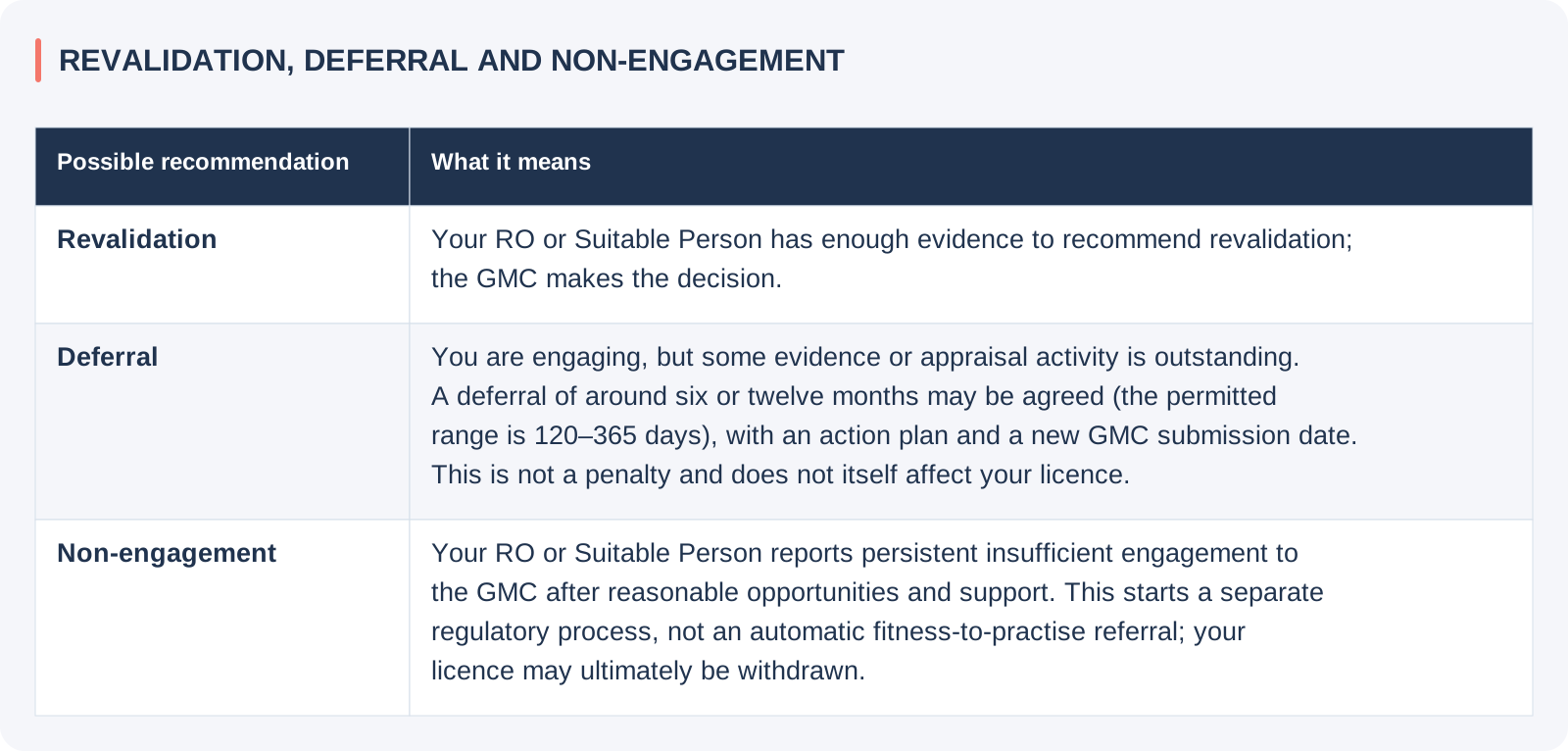
Revalidation, deferral and non-engagement
Revalidation
Your RO or Suitable Person has enough evidence to recommend revalidation; the GMC makes the decision.
Deferral
You are engaging, but some evidence or appraisal activity is outstanding. A deferral of around six or twelve months may be agreed (the permitted range is 120–365 days), with an action plan and a new GMC submission date. This is not a penalty and does not itself affect your licence.
Non-engagement
Your RO or Suitable Person reports persistent insufficient engagement to the GMC after reasonable opportunities and support. This starts a separate regulatory process, not an automatic fitness-to-practise referral; your licence may ultimately be withdrawn.
Read the text version
| Possible recommendation | What it means |
|---|---|
| Revalidation | Your RO or Suitable Person has enough evidence to recommend revalidation; the GMC makes the decision. |
| Deferral | You are engaging, but some evidence or appraisal activity is outstanding. A deferral of around six or twelve months may be agreed (the permitted range is 120–365 days), with an action plan and a new GMC submission date. This is not a penalty and does not itself affect your licence. |
| Non-engagement | Your RO or Suitable Person reports persistent insufficient engagement to the GMC after reasonable opportunities and support. This starts a separate regulatory process, not an automatic fitness-to-practise referral; your licence may ultimately be withdrawn. |
Deferral is often the sensible route when someone is engaging but their appraisal record or supporting information is incomplete. Six or twelve months may be enough to complete an outstanding appraisal, obtain feedback or finish other evidence. Your RO should agree what needs to be done and by when. A deferral is not a fitness-to-practise finding, and your licence remains in place while you address the requirements.
Non-engagement is different. If a doctor repeatedly fails to engage despite appropriate support and opportunities, their RO or Suitable Person can make a formal recommendation of non-engagement to the GMC. The GMC then contacts the doctor, considers their explanation and decides whether their licence should be withdrawn. This is a revalidation-related regulatory process distinct from fitness-to-practise proceedings, although separate fitness-to-practise concerns can also exist.
The practical message? If you have gaps, don’t ignore them. Contact your RO or appraisal team, explain what happened and agree a realistic plan. A missing appraisal and a refusal to engage are not the same thing.
What if you don’t have a Designated Body?
This is particularly relevant if you’re an IMG, an independent locum or between posts. Not having a Designated Body isn’t, by itself, a problem. You can still meet your annual revalidation requirements; you just need to organise them yourself rather than relying on an NHS trust or another organisation to do it for you.
The important distinction is between what you need to do each year and what happens when your five-year revalidation date arrives.
What you need to do each year
If you have neither a Responsible Officer (RO) nor an approved Suitable Person, the GMC normally expects three things:
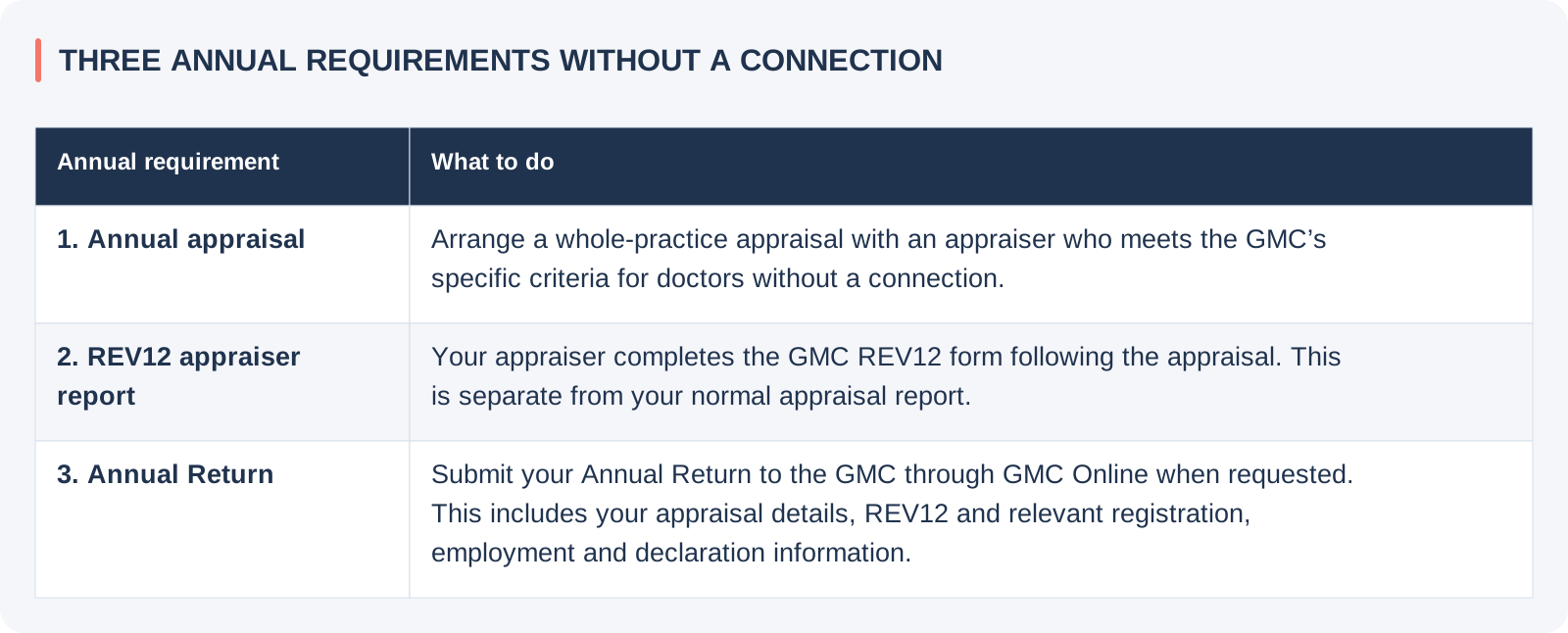
Three annual requirements without a connection
1. Annual appraisal
Arrange a whole-practice appraisal with an appraiser who meets the GMC’s specific criteria for doctors without a connection.
2. REV12 appraiser report
Your appraiser completes the GMC REV12 form following the appraisal. This is separate from your normal appraisal report.
3. Annual Return
Submit your Annual Return to the GMC through GMC Online when requested. This includes your appraisal details, REV12 and relevant registration, employment and declaration information.
Read the text version
| Annual requirement | What to do |
|---|---|
| 1. Annual appraisal | Arrange a whole-practice appraisal with an appraiser who meets the GMC’s specific criteria for doctors without a connection. |
| 2. REV12 appraiser report | Your appraiser completes the GMC REV12 form following the appraisal. This is separate from your normal appraisal report. |
| 3. Annual Return | Submit your Annual Return to the GMC through GMC Online when requested. This includes your appraisal details, REV12 and relevant registration, employment and declaration information. |
The GMC normally gives at least three months’ notice for your Annual Return. You should keep your evidence and ensure the REV12 is completed correctly. For most doctors who are organised, this annual process is manageable. It does not mean you need to pay a private Responsible Officer every year.
The bigger issue: what happens at revalidation?
This is where having no Designated Body can make a much bigger difference. When you reach your revalidation date, the GMC usually relies on a recommendation from an RO or an approved Suitable Person. An independent appraiser who has completed your annual REV12 cannot automatically make that recommendation.
You have two principal routes:
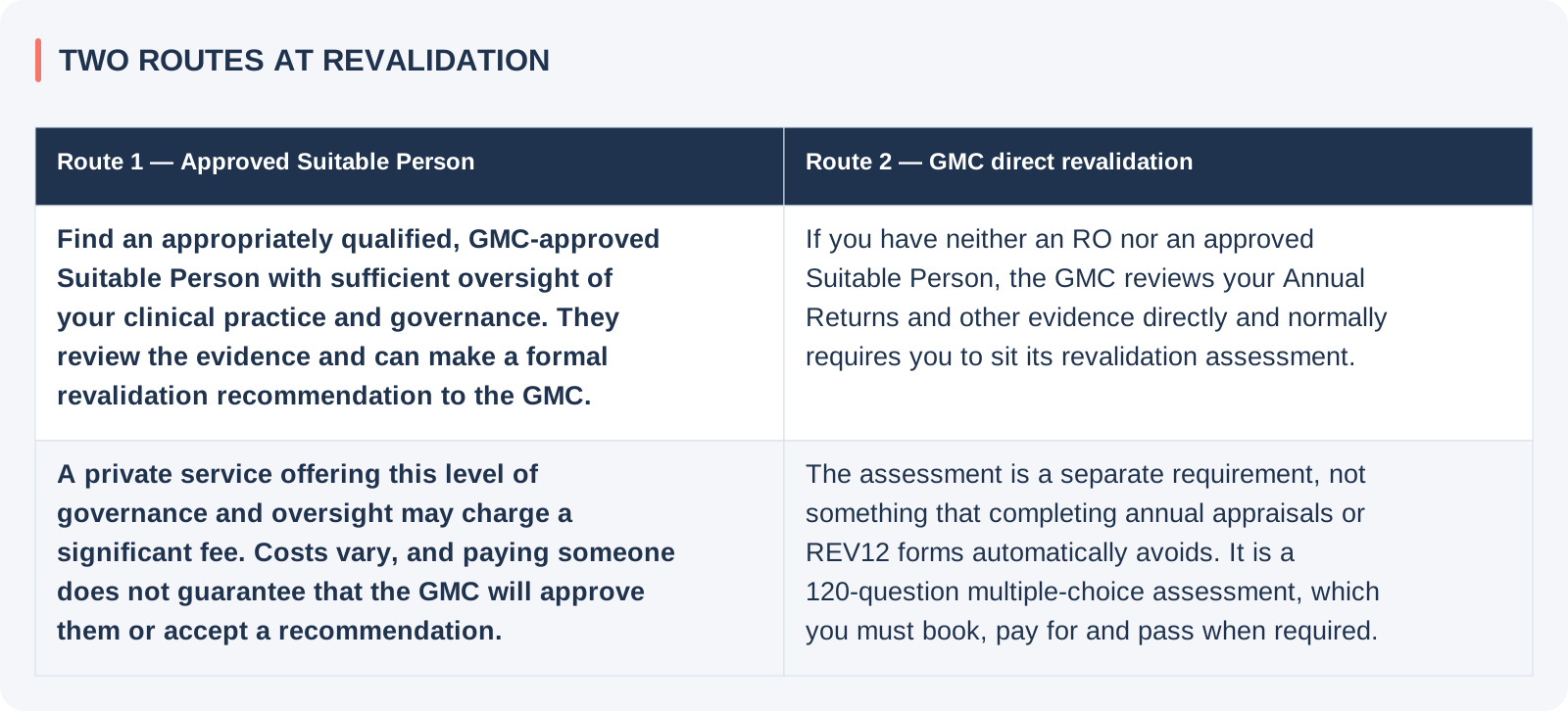
Two routes at revalidation
- Route 1 — Approved Suitable Person
- Find an appropriately qualified, GMC-approved Suitable Person with sufficient oversight of your clinical practice and governance. They review the evidence and can make a formal revalidation recommendation to the GMC.
- Route 2 — GMC direct revalidation
- If you have neither an RO nor an approved Suitable Person, the GMC reviews your Annual Returns and other evidence directly and normally requires you to sit its revalidation assessment.
- Route 1 — Approved Suitable Person
- A private service offering this level of governance and oversight may charge a significant fee. Costs vary, and paying someone does not guarantee that the GMC will approve them or accept a recommendation.
- Route 2 — GMC direct revalidation
- The assessment is a separate requirement, not something that completing annual appraisals or REV12 forms automatically avoids. It is a 120-question multiple-choice assessment, which you must book, pay for and pass when required.
Read the text version
| Route 1 — Approved Suitable Person | Route 2 — GMC direct revalidation |
|---|---|
| Find an appropriately qualified, GMC-approved Suitable Person with sufficient oversight of your clinical practice and governance. They review the evidence and can make a formal revalidation recommendation to the GMC. | If you have neither an RO nor an approved Suitable Person, the GMC reviews your Annual Returns and other evidence directly and normally requires you to sit its revalidation assessment. |
| A private service offering this level of governance and oversight may charge a significant fee. Costs vary, and paying someone does not guarantee that the GMC will approve them or accept a recommendation. | The assessment is a separate requirement, not something that completing annual appraisals or REV12 forms automatically avoids. It is a 120-question multiple-choice assessment, which you must book, pay for and pass when required. |
The GMC describes some exceptions to the assessment requirement, such as a newly confirmed RO/Suitable Person connection, reasonable circumstances or an approved alternative assessment. It is therefore more accurate to say the assessment is normally required on the direct route—not that the GMC simply chooses between revalidating you immediately or testing you.
At a glance: no Designated Body
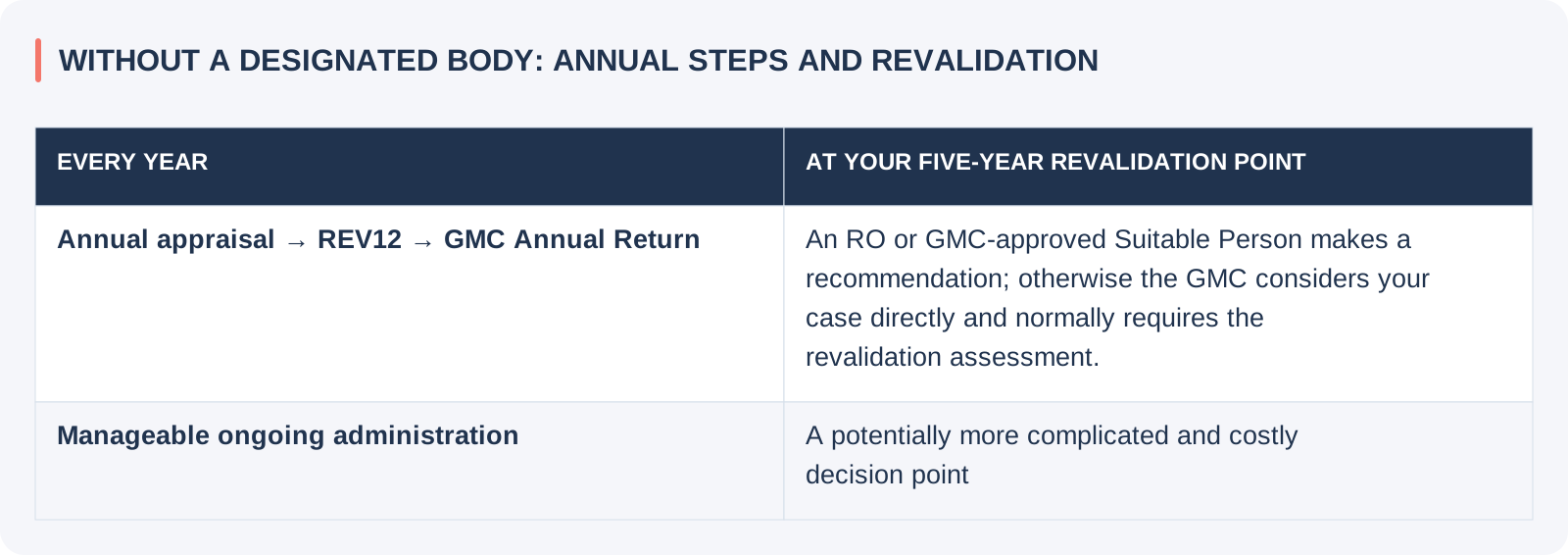
Without a Designated Body: annual steps and revalidation
- EVERY YEAR
- Annual appraisal → REV12 → GMC Annual Return
- AT YOUR FIVE-YEAR REVALIDATION POINT
- An RO or GMC-approved Suitable Person makes a recommendation; otherwise the GMC considers your case directly and normally requires the revalidation assessment.
- EVERY YEAR
- Manageable ongoing administration
- AT YOUR FIVE-YEAR REVALIDATION POINT
- A potentially more complicated and costly decision point
Read the text version
| EVERY YEAR | AT YOUR FIVE-YEAR REVALIDATION POINT |
|---|---|
| Annual appraisal → REV12 → GMC Annual Return | An RO or GMC-approved Suitable Person makes a recommendation; otherwise the GMC considers your case directly and normally requires the revalidation assessment. |
| Manageable ongoing administration | A potentially more complicated and costly decision point |
My advice
If you have no Designated Body, don’t panic about your annual appraisal—get it organised, make sure your appraiser meets the GMC criteria and submit the REV12 and Annual Return on time. But do check your revalidation date now. If it is approaching and you still have no RO or approved Suitable Person, speak to the GMC early about the direct route and assessment. If you are exploring a private Suitable Person arrangement, check their GMC approval, governance oversight and full costs before committing.
A few situations I get asked about regularly
I’m an F3 and expect to enter specialty training next year. Do I need appraisal?
If you’re outside GMC-approved training and hold a licence to practise, you should normally engage with annual appraisal rather than relying on next year’s plans.
I’m an IMG and haven’t started working in the NHS yet.
If you hold a GMC licence to practise, you need to engage with revalidation from the outset — even if you have not yet secured paid clinical work in the UK. That normally means arranging an annual whole-practice appraisal and keeping your GMC connection information up to date. If you have no Designated Body or Suitable Person, you will also need to follow the GMC Annual Return process, including REV12 where applicable.
If you have no paid clinical role, your appraisal can discuss relevant activity from clinical attachments or observerships, including supervised learning, case discussions, teaching, CPD, reflection and plans to return to practice. Be clear about what you actually did: observing consultations is not the same as delivering independent clinical care. An appraisal based on an observership may help show engagement and development, but it does not automatically demonstrate current clinical competence or guarantee successful revalidation. If you have no meaningful clinical activity or supporting information, discuss the limitations and next steps with your appraiser and the GMC early.
I’ve worked overseas for two years.
Relevant overseas practice and evidence can often form part of appraisal. Overseas work does not automatically remove UK licence-related responsibilities.
I’ve completed only three appraisals in five years. Will I fail?
Not necessarily. Your RO or Suitable Person considers gaps, their reasons and the overall available evidence.
I’ve completed appraisal. Does that mean I’m revalidated?
No. Appraisal contributes evidence, but GMC makes a separate decision when revalidation is due.
My practical advice
The best way to approach appraisal and revalidation is to avoid thinking about revalidation only every five years. A little organisation throughout the cycle makes a big difference.
- Check your revalidation date in GMC Online
- Confirm your Designated Body, RO, Suitable Person or GMC direct arrangements
- Make sure your annual appraisal is organised
- Keep a simple record of CPD, quality improvement and other evidence
- Arrange patient and colleague feedback in good time
- Address missed appraisals or evidence gaps early
The bottom line
Appraisal is normally annual; revalidation is normally every five years. They’re connected, but not identical.
Don’t rely on future training or employment plans. Understand your current arrangements.
Keep on top of evidence throughout the cycle. It is easier than resolving years of gaps shortly before your deadline.
Medical appraisal and revalidation can sound bureaucratic, but for most doctors they’re manageable once you understand how they work. The aim isn’t to catch you out. It’s to demonstrate that you continue to practise safely, reflect on your work and develop professionally.
If you’re unsure about your own arrangements, it’s much better to ask now than when your revalidation date is just around the corner.