The quick answer
You are normally expected to complete formal patient feedback and formal colleague feedback at least once during each revalidation cycle, usually five years. You do not need to complete either exercise at every annual appraisal. What matters is collecting feedback through a credible process, reflecting on what it says and discussing it at appraisal.
For the commonly used GMC-style questionnaires, 34 patient responses and 15 colleague responses are useful planning targets. Check the requirements of your chosen tool and responsible officer, as sample sizes and arrangements may differ.
Think in revalidation cycles, not individual appraisal years
As an appraiser, I would not regard the absence of formal feedback in a particular appraisal year as a problem on its own. Plenty of doctors undertake their feedback exercises in one or two years of the cycle and discuss them in their annual appraisals. However, in the year or two before revalidation, I will usually ask how those exercises are progressing.
If feedback is outstanding, a sensible Personal Development Plan (PDP) objective is to complete the patient or colleague exercise ahead of the next appraisal or revalidation date. We can then revisit it at the following appraisal. This is a normal, supportive part of appraisal planning.
What counts as proper formal feedback?
Formal feedback should be structured, reasonably representative and gathered through a confidential, impartial process. GMC questionnaires can be used, but they are not the only option. An appropriate established feedback platform is often easier because it handles invitations, collection and reporting.
A spreadsheet containing questions you have designed yourself is much less convincing. It is difficult to show that the questions were appropriate or that the respondents felt able to answer freely. Similarly, a handful of thank-you emails, although helpful as supporting information, does not replace a formal feedback exercise.
Patient feedback: what to collect and how
Use a recognised questionnaire that makes sense for your clinical setting. For the GMC patient questionnaire, patients generally reflect on the consultation they have just had.
Questions commonly explore courtesy, listening, explanation, involving patients in decisions and the care provided, with space for comments.
Electronic surveys are convenient, but paper questionnaires may be more accessible for some patient populations.
If using paper forms, ask a receptionist, nurse or other independent team member to distribute and collect them rather than doing it yourself.
Aim for a sufficiently varied and representative sample, review the combined results and preserve patient anonymity.
Colleague feedback: what to collect and how
Invite people who know your practice across the breadth of your role. Include different professions and levels of seniority, not only doctors or close friends.
Depending on your work, include nurses, physiotherapists, occupational therapists, junior doctors, peers, consultants and relevant administrative or management colleagues.
Common questionnaire themes include clinical judgement, prescribing, record keeping, professionalism, communication, supervision, teamwork and reliability.
A suitable platform can invite colleagues impartially, collect anonymous responses, show scores and summarise free-text themes.
The collection process in four steps
- 01Choose
Pick a credible questionnaire or independent platform appropriate for your scope.
- 02Invite
Gather a representative group; avoid cherry-picking respondents.
- 03Collate
Collect sufficient responses and obtain a consolidated, anonymised report.
- 04Reflect
Review scores and comments, write a short reflection and discuss the results at appraisal.
What does a good reflection look like?
As an appraiser, I want to see that you have looked at the feedback and thought about it. Charts and scores help, but you do not need a complicated analysis. A short, sensible reflection is usually fine.
How do your own ratings or expectations compare with those of patients and colleagues?
Are the scores broadly consistent? Do several comments point to the same strength or difficulty?
Was anything surprising, particularly a recurring lower score or constructive comment?
If something needs improving, what might explain it and what will you try differently?
Really positive feedback is common. Doctors often rate themselves more cautiously than their colleagues do. That is fine. You can say what went well and what you want to keep doing. There is no need to invent a weakness.
If someone raises a concern, do not ignore it. Think about whether it is a one-off comment or part of a pattern, and explain what you have learned. Do not try to work out who wrote an anonymous comment.
Example reflections
Example 1 — mainly positive feedback
“I was pleased with the positive comments about my communication and teamwork. They match how I try to work. Patients said they felt listened to, which is especially encouraging. I want to keep doing this well.”
Example 2 — a constructive theme
“A few colleagues felt my written handovers could be clearer. I tend to rely on verbal handover when things are busy, so I can see why this came up. I will use a more consistent written format and ask colleagues for feedback after a few weeks.”
Worked examples: reading your feedback
A feedback report shows the results. Your reflection explains what they mean for your practice. The examples below show how to bring the two together.
Patient feedback: scores and written comments
In this example, 22 patients responded. The doctor scored an average of 5.8 out of 6, and all 22 patients said they would recommend them. That is excellent feedback. The next step is to read the comments and see what patients particularly valued.
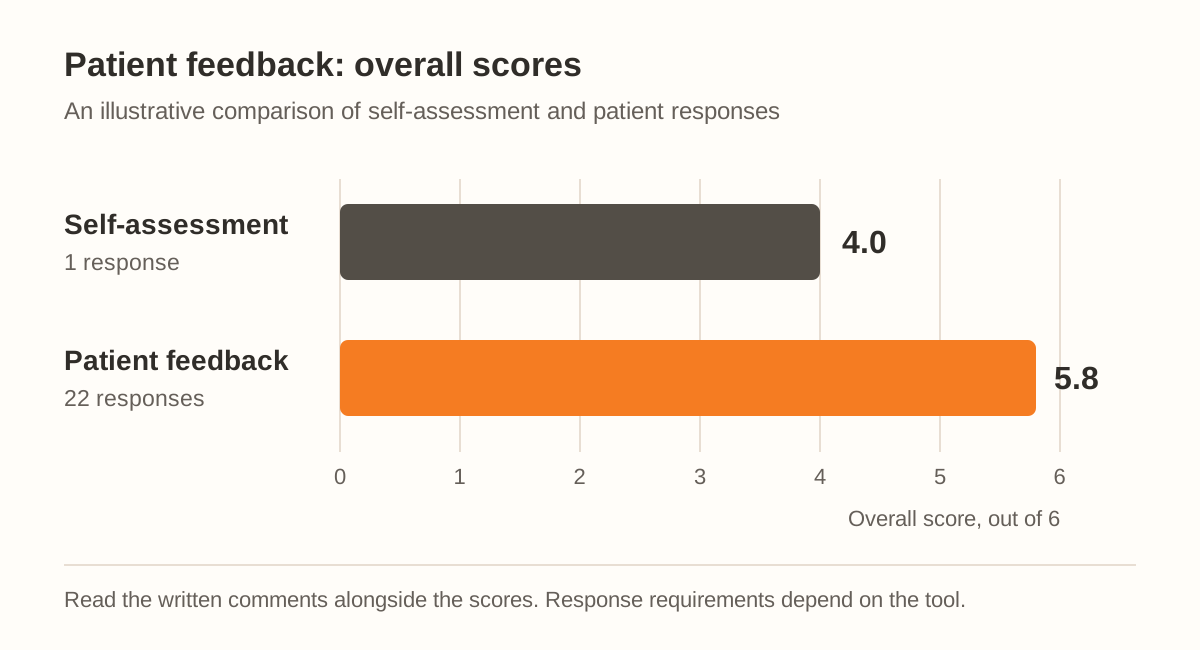 View full-size chart
- Patients who replied
- 22
- Overall score
- 5.8 / 6
- Would recommend
- 22 of 22
- What patients said
- Professional, reassuring, attentive, thorough, easy to understand; patients felt listened to, safe and involved
What would I say as an appraiser? These are really positive results. I would ask the doctor what they were pleased about, whether anything surprised them, and whether the patients surveyed reflect the range of work they do. A few sentences are enough.
Colleague feedback: strengths and suggestions
Here, colleagues gave positive feedback about clinical knowledge, communication, teamwork and professionalism. They also made a few suggestions. That is useful: the doctor can be pleased with the positive feedback and still pick out one thing to work on.
- Clinical knowledge and decisions
- Strong overall
- Communication and teamwork
- Positive overall; a few suggestions to improve team communication
- Leadership and professionalism
- Positive overall; room to develop further
- Written improvement themes
- Take part in more audit or QI; improve documentation and team communication
This table pulls together the comments. We have not invented any scores where the original report did not provide them.
Putting it together: what could the doctor actually write?
“I was pleased that patients and colleagues were positive about my communication and teamwork. I had rated myself a little lower, so it was reassuring to see their feedback. A few colleagues suggested I could get more involved in audit and governance work. I agree that would be useful, and I plan to join a local project over the next few months.”
That is enough. It says what went well, picks up a useful suggestion and explains what the doctor will do next. You do not need to invent a problem just because the feedback is positive.
Using the feedback report in your portfolio
Upload the feedback report, ideally with the number of responses, scores and comments. Take out any details that could identify patients or colleagues.
Checklist: what supporting evidence should you upload?
The simplest approach is to upload the feedback report and add a short reflection. Mention the main strengths, anything that surprised you, and one or two things you might improve. If a clear action comes out of it, you can add that to your PDP.
One thing to check: 22 patient responses and a score of 5.8/6 look good, but you should still check whether you collected enough responses for your chosen feedback tool. A great average score does not replace a proper collection process.
Common mistakes — and easy fixes
Using a homemade survey
Choose GMC questionnaires or an established formal tool with an appropriate confidential collection process.
Collecting responses in tiny fragments
Complete a coherent patient exercise and a coherent colleague exercise, with meaningful summary reporting.
Choosing only supportive colleagues
Invite an impartial cross-section of people who actually work with you.
Uploading the report without discussion
Add a brief reflection comparing your expectations with the outcomes and addressing any themes.
Leaving it until the final months
Use an appraisal discussion and PDP goal to plan the exercise well ahead of revalidation.
What if I do not see patients?
Doctors who do not have direct patient contact may be able to seek feedback from others who receive their medical services, such as learners, clients or professional service users. If meaningful patient or equivalent feedback genuinely cannot be obtained, discuss the approach with your Responsible Officer or Suitable Person rather than simply leaving the section blank.
Frequently asked questions
Do I need patient and colleague feedback every year?
No. The usual expectation is formal patient feedback and formal colleague feedback during each revalidation cycle, not both at every annual appraisal.
Do I have to use the GMC questionnaires?
No. A suitable established tool or platform may be appropriate. The important considerations are a sound questionnaire, fair selection, confidentiality and a meaningful report.
Are 34 and 15 absolute cut-offs?
They are widely used practical targets associated with GMC questionnaire research, but are not universal fixed minimums. Check what is appropriate for your chosen method and provider.
Does negative feedback automatically cause a problem?
Not necessarily. What matters is the nature and significance of the feedback, whether it fits a broader pattern, and how you reflect and respond. Significant concerns should not be ignored.
Does positive feedback need reflection?
Yes, but it can be brief and natural. Recognise strengths, compare feedback with your expectations and identify any relevant learning without inventing concerns.
The bottom line
Complete both formal exercises within your revalidation cycle, use a credible process, aim for enough responses to form a meaningful picture, and engage thoughtfully with the results. That is what I look for as an appraiser: evidence of a genuine feedback exercise and insight into your practice, not elaborate paperwork.
Sources and review
- Last reviewed
- 27 October 2026